
Meiji Jingu Omikuji Guide: Oomigokoro Waka Poems & Etiquette (2026)

"Meiji Jingu prints neither Daikichi nor Kyo on its slips—instead, every visitor receives Oomigokoro, a timeless 31-syllable imperial waka poem meant to guide daily conduct and inner peace."
Dedicated on November 1, 1920 (Taisho 9) inside a tranquil 70-hectare sacred forest in Shibuya, Tokyo, Meiji Jingu (明治神宮) enshrines Emperor Meiji (明治天皇) and Empress Shoken (昭憲皇太后) and welcomes more New Year worshippers than any other Shinto sanctuary in Japan. Travelers who step up to its wooden fortune counters expecting a "Great Blessing" or "Bad Luck" prediction are often surprised to unfold a sheet of fine paper bearing a classical verse and ethical reflection instead. Known as Oomigokoro (大御心, "The Great Imperial Heart"), Meiji Jingu's oracle tradition replaces fortune-telling anxiety with moral clarity. Here is the complete primary-source guide to all 30 imperial waka poems, Emperor Meiji's prayer for world peace, the 4-step ¥100 ritual (including official English slips), whether to tie or carry your slip home, and sunrise-to-sunset opening hours.
At a Glance: Four Essential Facts About Meiji Jingu Oomigokoro
- Zero Daikichi or Kyo Ranks: Meiji Jingu's Oomigokoro contains zero good-luck or bad-luck grades; every slip delivers direct ethical and spiritual counsel (人倫道徳の指針) for daily life.
- 30 Imperial Waka Poems (Odd vs. Even): Selected from over 120,000 verses by the enshrined imperial couple—15 Gyosei (御製) by Emperor Meiji appear on odd numbers (No. 1, 3, ..., 29) and 15 Miuta (御歌) by Empress Shoken appear on even numbers (No. 2, 4, ..., 30).
- ¥100 Hatsuhoryo & Official English Edition: After offering formal Shinto prayer (two bows, two claps, one bow), place a ¥100 Hatsuhoryo coin offering; Meiji Jingu provides both Japanese and official English Oomigokoro slips.
- Carry It Home as a Personal Compass: Because there is no Kyo misfortune to leave behind, Meiji Jingu encourages carrying your slip home in a wallet or journal rather than tying it up (and never onto live forest trees).
Before walking beneath Meiji Jingu's towering cypress torii gates—or from anywhere in the world—draw a traditional Japanese waka slip or enter quiet spiritual reflection online.
1. What Is Oomigokoro (大御心) & Why Meiji Jingu Has Zero Daikichi or Kyo
At Meiji Jingu, the sacred slip you draw is not a fortune-telling lottery ticket—it is officially named Oomigokoro (大御心, literally "The Great Imperial Heart") and contains zero fortune ranks such as Daikichi (大吉), Kichi (吉), or Kyo (凶). Inaugurated in New Year 1947 (Showa 22) under Meiji Jingu's post-WWII supervision after the shrine transitioned from state administration to an independent religious institution, Oomigokoro was designed so worshippers would never be swayed by transient superstition over good or bad luck, but instead receive enduring ethical and spiritual guidance (人倫道徳の指針) directly from the enshrined deities.
During their lifetimes, Emperor Meiji (1852–1912) and Empress Shoken (1849–1914) were prolific masters of classical 31-syllable Japanese poetry (waka, structured in 5-7-5-7-7 meter), composing more than 120,000 poems combined—approximately 93,000 Gyosei (御製, the traditional honorific for poems composed by an Emperor) and roughly 30,000 Miuta (御歌, poems composed by an Empress). Out of that monumental literary corpus, Meiji Jingu scholars carefully selected 30 moral poems arranged in an alternating structure: 15 Gyosei by Emperor Meiji on odd-numbered slips (第1番, 第3番, ..., 第29番) and 15 Miuta by Empress Shoken on even-numbered slips (第2番, 第4番, ..., 第30番).
| Feature | Meiji Jingu "Oomigokoro" | Classical Kannon Hyakusen (Sensoji) | Standard 7-Rank Shrine Omikuji |
|---|---|---|---|
| Tradition | Shinto Sanctuary (神宮) | Buddhist Temple (寺院) | General Shinto Shrines (神社) |
| Poetic Corpus | 30 Imperial Waka (15 Gyosei + 15 Miuta, 31 syllables) | 100 Classical Chinese Quatrains (20 kanji each) | 50–100 slips (classical waka or moral maxims) |
| Fortune Ranks | Zero ranks (0 Daikichi, 0 Kyo) | 7 ranks (17% Daikichi, 35% Kichi, 30% Kyo) | 7–12 ranks (Daikichi to Kyo; usually <10% Kyo) |
| Offering & English | ¥100 Hatsuhoryo (Japanese & official English editions) | ¥100 Myogakin (English printed on reverse) | ¥100–¥200 Hatsuhoryo (varies by shrine) |
| After Drawing | Recommended to carry home as a daily moral compass | Keep good slips; tie Kyo at designated metal racks | Carry home or tie vow at designated Musubi-dokoro |
Travelers visiting both of Tokyo's most iconic sacred landmarks experience two profoundly different spiritual philosophies: Asakusa's Buddhist temple preserves a thousand-year-old 30% bad-luck ratio, whereas Harajuku's forested Shinto sanctuary transcends luck altogether. Explore both traditions in our Sensoji Temple 100-Slip Kannon Hyakusen Guide and Sensoji Temple vs. Meiji Shrine Comparison.
2. Representative Verified Waka in Oomigokoro & Emperor Meiji's Vision of World Peace
Each Oomigokoro slip pairs a 31-syllable imperial waka and its classical theme (題, Dai) with modern ethical commentary—exemplified by Slip No. 1 on pure sincerity (Makoto), Slip No. 16 on self-cultivation, Slip No. 17 on morning clarity, and Slip No. 25 on open-hearted magnanimity—reflecting the universal spirit of world peace expressed in Emperor Meiji's renowned 1904 Yomo no umi verse.
Slip No. 1 (第1番) | Gyosei by Emperor Meiji — Theme: "Deities of Heaven and Earth" (神祇)
"目に見えぬ 神にむかひて はぢざるは 人の心の まことなりけり"
Me ni mienu / kami ni mukaite / hajizaru wa / hito no kokoro no / makoto narikeri
Translation & Moral Counsel: "To stand before the unseen Kami without a trace of shame—that alone is true sincerity in the human heart." Placed deliberately as Slip No. 1, this verse defines Shinto's highest ethical ideal, Makoto (誠, pure sincerity): living with an upright conscience even in complete solitude when nobody else is watching.
Slip No. 16 (第16番) | Miuta by Empress Shoken — Theme: "Diligence" (勤労)
"みがかずば 玉の光は いでざらむ 人のこころも かくこそあるらし"
Migakazuba / tama no hikari wa / idezaramu / hito no kokoro mo / kaku koso arurashi
Translation & Moral Counsel: "Left unpolished, even a precious gem emits no radiance; truly, the human heart is fashioned in the very same way." Composed by Empress Shoken—a lifelong patron of women's education and Red Cross humanitarianism—this poem reminds us that innate talent means little without patient daily learning, humility, and self-cultivation.
Slip No. 17 (第17番) | Gyosei by Emperor Meiji — Theme: "The Sun" (日)
"さしのぼる 朝日のごとく さはやかに もたまほしきは 心なりけり"
Sashinoboru / asahi no gotoku / sawayaka ni / motamahoshiki wa / kokoro narikeri
Translation & Moral Counsel: "Bright, clear, and refreshing as the rising morning sun—such is the heart one ever wishes to keep." Whenever worry or resentment clouds our judgment, this verse invites us to reset our posture each dawn with clarity, warmth, and quiet gratitude.
Slip No. 25 (第25番) | Gyosei by Emperor Meiji — Theme: "Heaven & Sky" (天)
"あさみどり 澄みわたりたる 大空の 広きをおのが 心ともがな"
Asamidori / sumiwataritaru / oozora no / hiroki wo onoga / kokoro tomogana
Translation & Moral Counsel: "Vast and cloudless as the pale-green expanse of open sky—would that I might make such breadth my own heart." A serene call to broaden one's perspective, forgive petty grievances, and embrace others with magnanimity.
Universal Brotherhood & World Peace: Emperor Meiji's 1904 Peace Gyosei
Beyond the numbered 1–30 Oomigokoro slips, the deeper spiritual ethos of Meiji Jingu is crystallized in Emperor Meiji's most famous peace Gyosei, composed in 1904 (Meiji 37) as an emblematic prayer for global harmony:
"よもの海 みなはらからと 思ふ世に など波風の たちさわぐらむ"
Yomo no umi / mina harakara to / omou yo ni / nado namikaze no / tachisawaguramu
"In a world where we regard all peoples across the four seas as brothers and sisters, why do winds and waves stir up conflict?"
Recited at international peace gatherings and admired by visiting heads of state for over a century, this poem expresses the essence of Shinto Sanpai (参拝, shrine pilgrimage): stepping out of urban noise into a living forest to cultivate gratitude, examine one's own heart, and pray for peaceful coexistence across all cultures. For quiet contemplation from afar, visit our Divine Oracle Reflection.
3. 4-Step Etiquette for Drawing Oomigokoro at Meiji Jingu (¥100 & English Slips)
To draw Oomigokoro at Meiji Jingu in four steps, first purify at the Temizuya and offer formal Shinto prayer (Nihai Nihakushu Ippai: two bows, two claps, one bow) at the Main Sanctuary, offer a ¥100 Hatsuhoryo coin at the Outer Worship Hall counter, gently shake the wooden Furi-mikuji shaker cylinder to draw a stick numbered 1–30 before returning it, and receive your matching slip in either Japanese or the official English edition.
Purify at the Temizuya & Offer Formal Shinto Prayer (Nihai Nihakushu Ippai)
Before approaching the omikuji stand, rinse your left hand, right hand, and mouth at the stone water pavilion (Temizuya), then approach the Main Sanctuary. Perform traditional Shinto worship—Nihai Nihakushu Ippai (二拝二拍手一拝: two deep bows, two crisp claps at chest height, silent gratitude, and one final deep bow)—unlike Buddhist temples where worshippers press palms silently without clapping.
Proceed to the Counter & Offer ¥100 Hatsuhoryo (Japanese or Official English Slip)
Step over to the omikuji stand or award counter in the courtyard and place a ¥100 coin as Hatsuhoryo (初穂料, Shinto ritual offering; keep a ¥100 coin ready). First introduced in 1968 for the Meiji Centenary, Meiji Jingu's official English Oomigokoro ("Omigokoro") edition prints the imperial waka, an elegant English poetic rendering, and practical moral commentary on fine washi-style paper right alongside the Japanese edition.
Gently Shake the Wooden Shaker Cylinder Until One Stick (1–30) Emerges
Hold the wooden shaker cylinder (Furi-mikuji, 振りみくじ) calmly with both hands while reflecting on how you ought to live in the months ahead. Tilt and shake gently until one numbered wooden stick (1 through 30) emerges from the small opening, read the number clearly, and slide the stick straight back inside the cylinder.
Receive Your Matching Oomigokoro Slip (No. 1–No. 30) & Read Quietly
At staffed counters, tell the shrine maiden (Miko, 巫女) your number to receive the matching slip; at self-service stands, locate the compartment marked with your number (第1番–第30番) and take one single sheet. Step aside beneath the courtyard eaves to read the poem and modern teaching (Mi-oshie) quietly.
4. Should You Tie Oomigokoro at Meiji Jingu or Carry It Home?
Because Meiji Jingu's Oomigokoro contains zero Kyo (bad fortune) to leave behind and Meiji Jingu installs no omikuji-tying racks on its grounds, carrying your slip home in a wallet or journal is the proper practice—never tie paper slips to live forest trees, and return year-old slips to a shrine's Koshinsatsu-osamedokoro receptacle.
- Keep It in Your Wallet, Journal, or Bookmark: Treat your Oomigokoro as a portable piece of wisdom to reread whenever you face a difficult decision or turbulent week. See our complete Guide to Keeping & Returning Good Omikuji for respectful storage ideas.
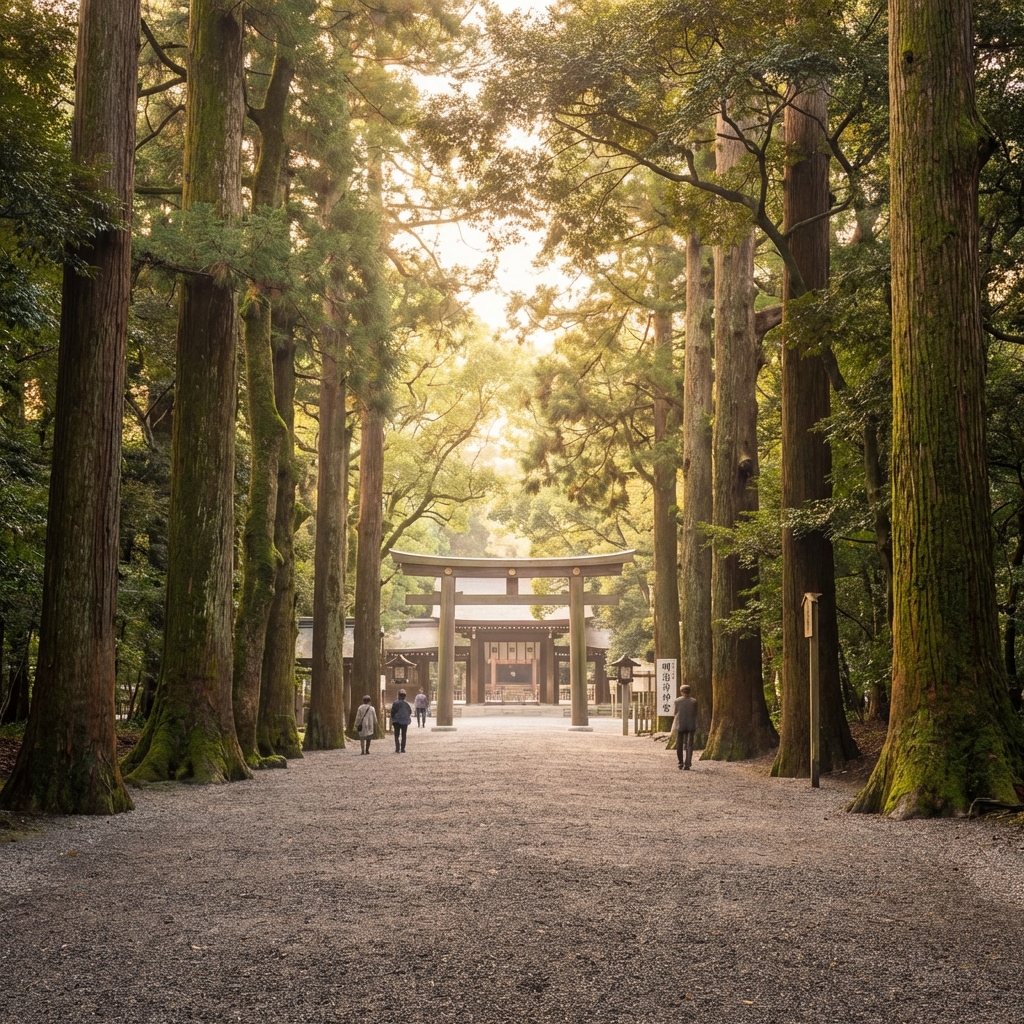
- No Omikuji-Tying Racks on the Grounds — Never Tie Slips to Live Forest Trees: Unlike shrines that issue Kyo fortunes, Meiji Jingu intentionally provides no omikuji-tying racks (Musubi-dokoro) because every Oomigokoro verse is meant to be carried home and reread. Never tie paper slips onto live trees, branches, or railings of Meiji Jingu's 100-year sacred forest—planted from 100,000 donated trees across Japan—as tight knots scar living bark (review full sanctuary manners in our Japan Shrine Etiquette Guide).
- Returning Old Slips After a Year (Koshinsatsu-osamedokoro): When a year has passed or you return to Meiji Jingu for a new verse, bring your old slip back with gratitude to the shrine's old-talisman receptacle—Koshinsatsu-osamedokoro (古神札納め所 / 古神符納所, located beside the South Temizuya)—for respectful ritual purification.
5. Meiji Jingu Opening Hours (Sunrise to Sunset), Counter Locations & Access
Meiji Jingu stands a 1-minute walk from JR Harajuku Station and opens 365 days a year from sunrise to sunset (roughly 5:00 AM in June to 6:40 AM in winter for opening, and 4:00 PM in December to 6:30 PM in June for closing), while the main award counters (長殿 / 授与所) generally operate from around 8:00–8:30 AM until gate closing.
| Shrine & Deities | Meiji Jingu (明治神宮) — Enshrining Emperor Meiji & Empress Shoken (Founded November 1, 1920) |
|---|---|
| Address | 1-1 Yoyogi-Kamizonocho, Shibuya-ku, Tokyo 151-8557 |
| Gate Hours (Daily) | Open 365 days from Sunrise to Sunset (varies monthly) Seasonal guide: June ~5:00 AM – 6:30 PM / March ~5:40 AM – 5:20 PM / October ~5:40 AM – 4:40 PM / December ~6:40 AM – 4:00 PM (January closes ~4:20 PM) |
| Counters & Offering | ¥100 Hatsuhoryo (cash ¥100 coin; Japanese & official English Oomigokoro available) Main award counters (Nagadono / Juyosho) open around 8:00–8:30 AM (up to 9:00 AM seasonally) until closing. Allow 10 minutes on foot from the outer Torii gate to the Main Sanctuary. |
| Nearest Stations | 1-minute walk to South Entrance from JR Harajuku Station (Omotesando / West Exit) or Meiji-jingumae 'Harajuku' Station (Chiyoda & Fukutoshin Lines); ~5-minute walk from Yoyogi or Sangubashi Stations |
Planning a full morning beneath the giant cypress torii gates, sake and Burgundy wine barrels, and Inner Garden iris paths? Read our Complete Meiji Jingu Visitor Guide, compare Tokyo's top two sacred sites in Sensoji vs. Meiji Shrine, or draw your Daily Online Omikuji before your visit.
Frequently Asked Questions
- Why does Meiji Jingu’s Oomigokoro omikuji have no Daikichi or Kyo fortune ranks?
- Rather than dividing fate into fleeting good or bad luck, Meiji Jingu bestows Oomigokoro ("The Great Imperial Heart")—30 classical moral waka poems comprising 15 Gyosei by Emperor Meiji on odd numbers and 15 Miuta by Empress Shoken on even numbers—offering enduring ethical guidance and inner peace.
- How much does Meiji Jingu’s omikuji cost and is an English version available?
- The Hatsuhoryo offering is ¥100. After offering Shinto worship at the Main Hall (two deep bows, two claps, silent gratitude, and one bow), shake the wooden cylinder to draw a stick numbered 1 to 30. Official English Oomigokoro slips with translated waka and commentary are available alongside Japanese slips.
- Should I tie my Oomigokoro slip at Meiji Jingu or take it home?
- Because Oomigokoro contains zero Kyo (bad luck) and serves as personal counsel for daily living, Meiji Jingu encourages carrying the washi slip home in your wallet or notebook to reread throughout the year (and never tying paper onto living trees in the sacred forest).
Draw Your Omikuji Online
Draw an authentic omikuji at our digital shrine to discover your fortune and receive a sacred message.
More Japanese shrine traditions
January 31, 2026
Meiji Shrine Tokyo: Complete Guide to Japan's Most Important Shinto Shrine (2026)
Visit Meiji Shrine (Meiji Jingu) in Tokyo with our complete guide. Learn about its history, forest walk, wedding ceremonies, best times to visit, and nearby attractions in Harajuku.

February 15, 2026
Sensoji vs. Meiji Shrine: The Ultimate Tokyo Showdown
Compare Sensoji Temple and Meiji Shrine in Tokyo. Discover the key differences between Shinto and Buddhism, architectural styles, and visiting tips.

May 23, 2026
Should You Keep Good Omikuji Fortunes? Shrine Amulet Guide
Should you keep a Daikichi (Great Blessing) omikuji or tie it? Learn the proper Japanese etiquette for handling good fortunes, carrying them as protective charms, and returning them.