
Japanese New Year: Kadomatsu, Shimekazari & Kagami Mochi (2026)
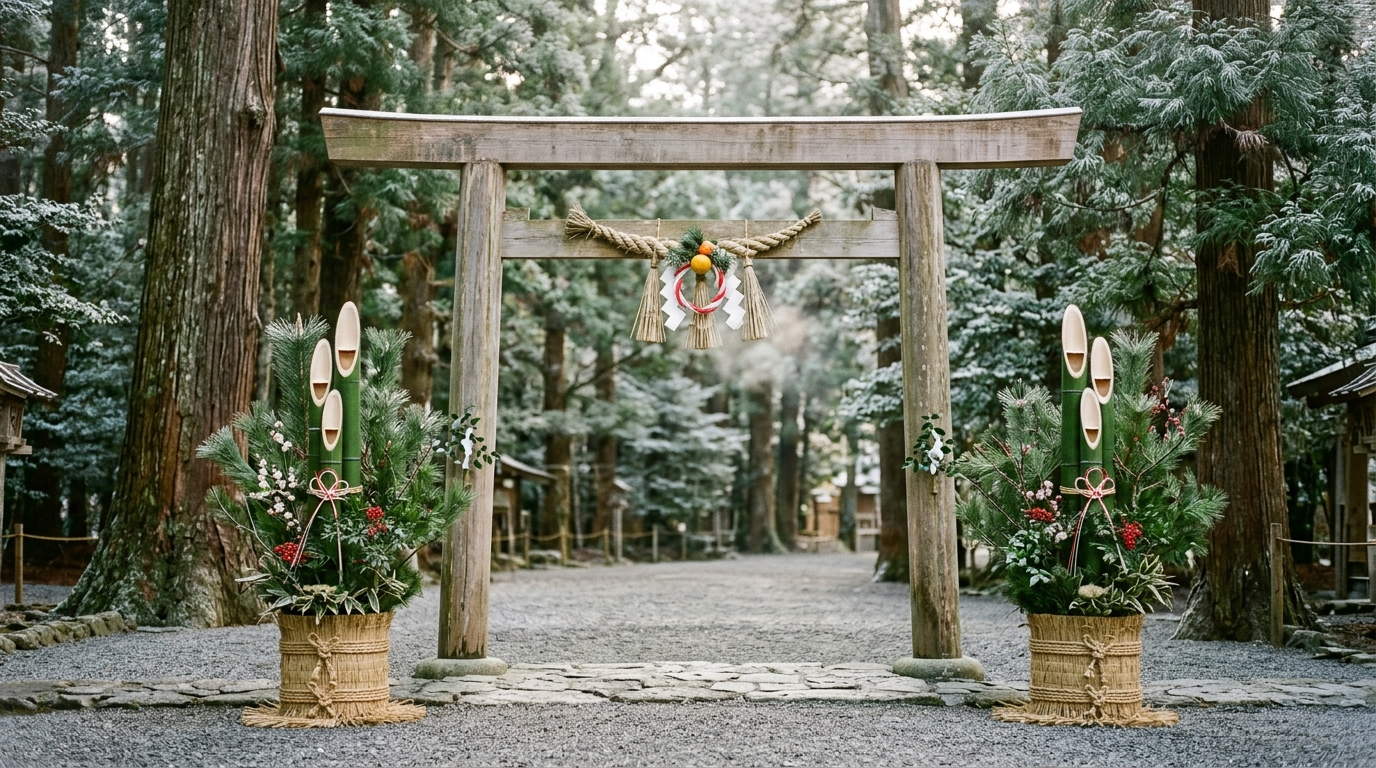
"Kadomatsu marks the gate, Shimekazari sanctifies the threshold, and Kagami Mochi invites the deity inside—Japanese New Year decorations are a complete household Shinto ritual."
Every late December across Japan, pine-and-bamboo arrangements, braided straw wreaths, and stacked round rice cakes appear at doorways and living rooms. Known as Kadomatsu, Shimekazari, and Kagami Mochi, these three Oshogatsu (New Year) ornaments exist to welcome Toshigami-sama, the Shinto deity of the New Year, into the family home. This guide explains their Shinto theology, symbolism, auspicious and taboo decorating dates (December 28 vs. 29 and 31), regional Matsu-no-uchi differences between Kanto and Kansai, Kagami Biraki etiquette, and respectful disposal via Dondoyaki bonfires or home salt purification.
As you prepare your home and heart for the New Year, pause for a quiet Shinto reflection and draw a free traditional Japanese omikuji fortune slip to set your intention for the year ahead.
30-Second Summary: Oshogatsu Decorations, Dates & Etiquette
- Three Sacred Roles: Kadomatsu guides Toshigami as a yorishiro (sacred vessel) at the gate; Shimekazari creates a purified kekkai boundary at the door; Kagami Mochi serves as the deity's indoor vessel and offering.
- Best & Taboo Dates: Traditional setup begins after December 13 (commonly Dec 26–28 today). December 28 is the most auspicious day (the kanji 八 widens downward for growing fortune), with December 30 as a backup. Avoid December 29 (ku = suffering) and December 31 (ichiyakazari, disrespectful one-night setup).
- Kanto vs. Kansai Dates: Matsu-no-uchi (when decorations come down) runs until January 7 in Kanto, Tohoku, and Kyushu, and until January 15 in Kansai and Shikoku. Kagami Biraki takes place on January 11 in Kanto, January 15 or 20 in Kansai, and January 4 in parts of Kyoto—never using a knife.
- Respectful Disposal: Return natural decorations to a shrine's Dondoyaki bonfire around January 15, or purify them at home on clean white paper with coarse sea salt sprinkled left, right, left before wrapping neatly.
1. Toshigami-sama: The Shinto Theology Behind Japanese New Year
In Shinto tradition, Oshogatsu (New Year) is far more than a calendar countdown. It is a household rite of hospitality dedicated to welcoming Toshigami-sama (歳神様 / 年神様)—the ancestral and agricultural deity of the New Year who descends from the mountains or heavens into each purified home at dawn on January 1. Toshigami bestows abundant harvests (gokoku hōjō), good health (mubyō sokusai), family harmony, and renewed life force (mitama) for the coming twelve months.
This ancient belief even explains the origin of Otoshidama (年玉), today's monetary New Year gift for children. Originally, toshidama meant "year-spirit" (toshidama / 歳魂): the vital spirit of Toshigami was believed to infuse the round rice cakes offered on the household altar, and the head of the household would divide and distribute pieces of that sacred mochi to each family member so everyone received a fresh year of vitality.
Welcoming Toshigami properly begins with cleaning both home and spirit before year's end—a theme deeply tied to shrine purification rites in our Oharai Shinto Purification Guide. Once the New Year dawns, households complement these home rituals with their first shrine pilgrimage of the year, covered in full in our Hatsumode New Year Shrine Visit Guide.
Draw an authentic omikuji at our digital shrine to discover your fortune and receive a sacred message.
2. The Three Pillars of Oshogatsu: Kadomatsu, Shimekazari & Kagami Mochi
Rather than acting as isolated seasonal trinkets, Japan's three classic New Year ornaments operate together as a three-part spiritual welcome: signaling the home from outside, sealing the doorway in purity, and hosting Toshigami inside.
| Decoration | Shinto Function | Traditional Placement | Core Elements & Symbolism |
|---|---|---|---|
| Kadomatsu (門松 / Gate Pine) |
Yorishiro (依代) landmark guiding Toshigami straight to the home | Flanking the gate or front entrance as a matched left-and-right pair | Pine (evergreen longevity), Bamboo (upright vitality; diagonal sogi or level zundo cut), Plum (resilient winter hope) |
| Shimekazari (しめ飾り / Sacred Wreath) |
Kekkai (結界) spiritual boundary marking a purified precinct | Hung on the front door, eaves, or entranceway | Shimenawa straw rope, zigzag Shide paper, Daidai bitter orange (generations), Urajiro fern (longevity & honesty), Yuzuriha leaf (succession) |
| Kagami Mochi (鏡餅 / Mirror Mochi) |
Yorishiro & offering where Toshigami's spirit resides indoors | Placed in the tokonoma alcove, near a kamidana, or in a tidy living room | Two stacked round mochi modeled after ancient bronze sacred mirrors, topped with Daidai, set on Shihobeni paper, Sanpo wooden stand & Gohei/Shide |
A. Kadomatsu (門松): The Gate Landmark & Yorishiro
Placed in a symmetrical left-and-right pair outside gates and storefronts, Kadomatsu serve as the visible beacon and temporary vessel (yorishiro) allowing Toshigami to descend without losing the way. Its botanical triad—known as Shōchikubai—carries layered meaning:
- Pine (Matsu / 松): Remaining green even in midwinter snow, pine embodies longevity, constancy, and waiting to welcome the kami.
- Bamboo (Take / 竹): Growing straight and resilient through winter winds, bamboo represents vigorous life force. Traditional craftsmanship features two cut styles: the crisp diagonal cut called sogi (削ぎ) and the level horizontal cut called zundo (寸胴).
- Plum Blossom (Ume / 梅): As the earliest tree to bloom in winter's chill, plum represents courage, renewal, and auspicious beginnings.
B. Shimekazari (しめ飾り): The Purified Doorway Boundary
Hung on the front door after year-end cleaning, Shimekazari announces that the house has been cleansed of stagnant impurity (kegare) and transformed into a temporary sacred precinct ready for Toshigami. Its braided straw rope and folded white lightning-shaped paper streamers share their root theology with shrine sanctuary ropes—explored year-round in our Shimenawa & Shide Sacred Rope Meaning Guide—while adding seasonal auspicious botanicals:
- Daidai (橙 / Bitter Orange): Because the fruit clings to its branch for years, its name is a homophone for daidai ("generation after generation"), praying for enduring family prosperity.
- Urajiro (裏白 / Gleichenia Fern): An evergreen fern with a bright white underside symbolizing growing white-haired together in longevity and keeping a pure, open heart with nothing hidden.
- Yuzuriha (譲り葉 / Daphniphyllum Leaf): Because old leaves fall only after fresh young leaves appear, it symbolizes smooth generational succession.
C. Kagami Mochi (鏡餅): The Sacred Mirror Offering Indoors
Inside the home, Kagami Mochi acts as Toshigami's resting vessel throughout the New Year period. Its smooth circular silhouette imitates ancient round bronze sacred mirrors (shinkyō), while stacking a smaller rice cake atop a larger one symbolizes the harmony of sun and moon, yin and yang, and the joyous layering of the old year and new year.
Traditionally, the twin mochi rest on an unfinished cypress stand called a sanpō (三方), lined with shihōbeni (四方紅)—white square paper bordered in red on all four sides to ward off misfortune from every direction—along with urajiro fern, folded gohei / shide streamers, and a daidai orange crowning the top. Note that these seasonal Toshigami decorations differ from year-round domestic Shinto worship and folk lucky charms: for everyday altar offerings see our Kamidana Home Altar Practical Guide, for enshrining shrine paper talismans see our Ofuda Shinto Talisman Guide, and for lucky charms such as hamaya arrows, daruma, and maneki-neko see our Japanese Lucky Charms (Engimono) vs. Omamori Guide.
3. When to Put Up Oshogatsu Decorations: Best Days & Taboo Dates
In traditional calendars, New Year preparations begin on December 13—Shōgatsu Kotohajime (the official start of New Year preparations and Susuharai soot-sweeping). Decorations may be put up any time from December 13 onward, though modern Japanese households typically decorate between December 26 and 28 once Christmas displays are stored and year-end cleaning is complete.
| December Date | Etiquette Status | Traditional Meaning & Reasoning |
|---|---|---|
| December 13–25 | Permitted (Traditional Opening) | December 13 marks Shōgatsu Kotohajime (Susuharai cleaning). Any day after this date is historically acceptable once cleaning is finished. |
| December 26–27 | Good (Modern Standard) | Popular, calm window right after Christmas that allows unhurried setup before the final rush of the year. |
| December 28 | Best Day (Most Auspicious) | The kanji for eight (八) widens gracefully at the base—known as suehirogari—symbolizing expanding good fortune throughout the coming year. |
| December 29 | Avoid (Taboo Date) | In Japanese, nine (九) shares its reading ku with 苦 (suffering), evoking unlucky wordplay such as nijūku ("double suffering") or kumatsu ("suffering pine"). |
| December 30 | Acceptable Backup | The recommended fallback if you miss December 28. Although strict traditionalists recall that Dec 30 was New Year's Eve in the old lunisolar calendar, it is widely accepted today. |
| December 31 | Strictly Avoid (One-Night Setup) | Called Ichiyakazari (一夜飾り / one-night decoration): setting up only the night before New Year's Day is seen as hurried and insincere toward Toshigami, recalling rushed funeral preparations. |
Practical Tip: What If You Miss December 28?
Skip December 29 and calmly place your decorations on the morning of December 30. Avoid waiting until December 31—sincere hospitality toward Toshigami values unhurried preparation over last-minute rushing.
4. Matsu-no-uchi & Kagami Biraki: Kanto vs. Kansai Regional Differences
The sacred span during which Toshigami stays within the household is called Matsu-no-uchi (松の内). When Matsu-no-uchi concludes, families remove their Kadomatsu and Shimekazari, followed shortly afterward by Kagami Biraki (鏡開き)—the ceremony of opening and eating the Kagami Mochi. Both dates show clear regional traditions between eastern and western Japan:
| Milestone | Kanto, Tohoku & Kyushu | Kansai, Shikoku & Parts of Kyoto |
|---|---|---|
| Matsu-no-uchi (Removal of Kadomatsu & Shimekazari) |
Until January 7 (Seven-Herb Porridge Day). During the Edo period, shogunate decrees linked to fire prevention and urban order shortened the period to Jan 7, establishing the eastern norm. | Until January 15 (Koshōgatsu, Little New Year), preserving the older traditional duration and aligning removal with mid-January shrine bonfires. |
| Kagami Biraki (Opening & Eating Kagami Mochi) |
January 11 is the standard date across Tokyo and eastern Japan. | January 15 (or January 20 in certain areas), while parts of Kyoto observe Kagami Biraki as early as January 4. |
Why You Never Cut Kagami Mochi with a Knife
When taking down Kagami Mochi on Kagami Biraki, never cut the rice cakes with a kitchen knife or blade. In samurai-era etiquette, slicing with a blade evoked ritual seppuku; spiritually, cutting a deity's vessel implies severing your auspicious bond with Toshigami.
Instead, dried Kagami Mochi is broken apart gently by hand or tapped open with a wooden mallet (kizuchi)—and rather than saying "cut" (kiru) or "break" (waru), Japanese tradition uses the auspicious verb hiraku (開く, "to open"), symbolizing the opening of good fortune. Simmering every piece into savory ozōni soup or sweet red-bean oshiruko without waste practices Naorai (直会): sharing consecrated food to receive Toshigami's health and vitality for the year ahead.
5. Dondoyaki Bonfires & Respectful Home/Overseas Salt Disposal
Around January 15 (Koshōgatsu), Shinto shrines and local communities hold sacred fire ceremonies called Dondoyaki (どんど焼き) or Sagichō (左義長)—part of the broader Otakiage fire purification custom. Returning natural Kadomatsu and Shimekazari to a shrine's Dondoyaki fire or Kosatsu-osamedokoro collection pavilion sends Toshigami respectfully back to heaven on the rising smoke. Before bringing decorations to a shrine, always remove non-combustible metal wires, plastic hooks, and synthetic ornaments (and remember that Kagami Mochi itself is eaten, with commercial plastic casings sorted as regular household recycling or waste).
If you live in a city area without a nearby bonfire—or observe Oshogatsu outside Japan—you can respectfully release natural New Year decorations at home using traditional Shinto salt purification in four calm steps:
Lay Out Clean White Paper (Hanshi or Washi)
Spread a fresh sheet of plain white hanshi or washi paper on a tidy surface and place the decoration gently in the center. Separate any metal wire or synthetic fasteners first so materials are sorted cleanly.
Purify with Coarse Sea Salt: Left, Right, Left
Following Shinto purification etiquette, sprinkle a pinch of natural coarse sea salt (arajio) over the decoration in a deliberate left, right, left sequence, returning the sacred vessel gently to ordinary natural materials.
Offer Quiet Gratitude and Wrap Neatly
Pause for a respectful bow to thank Toshigami for blessing the start of your year, then fold the white paper cleanly around the decoration so it is fully enclosed.
Keep Separate and Follow Local Municipal Sorting
Place the wrapped parcel in a clean bag kept apart from food scraps or messy household refuse, and dispose of it respectfully as burnable or general waste according to your local municipality's rules.
Frequently Asked Questions
- When should Japanese New Year decorations be put up, and why are December 29 and 31 taboo?
- Traditionally decorations may go up anytime after December 13 (Kotohajime), though modern households typically decorate between December 26 and 28, with December 28 prized as the most auspicious day because the kanji for eight (八) widens downward toward prosperity (December 30 is the fallback). December 29 is avoided because nine (ku) sounds like suffering, and December 31—known as Ichiyakazari ("one-night decoration")—resembles rushed funeral preparations and shows disrespect to Toshigami-sama.
- What roles do Kadomatsu, Shimekazari, and Kagami Mochi each play for Toshigami-sama?
- Kadomatsu acts as the outdoor landmark and vessel (yorishiro) guiding Toshigami-sama to the doorway; Shimekazari establishes a sacred boundary (kekkai) purifying the threshold; and Kagami Mochi, shaped like an ancient bronze mirror, serves as the indoor seat and offering where the deity's spirit dwells throughout New Year.
- How does Matsu-no-uchi differ between Kanto and Kansai, and what is Kagami Biraki etiquette?
- Matsu-no-uchi—the period before taking decorations down—lasts until January 7 in Kanto (and much of eastern Japan) versus January 15 (Koshogatsu) in Kansai. Kagami Biraki ("opening the mirror mochi") takes place on January 11 in Kanto and January 15 (or 20, and January 4 in parts of Kyoto) in Kansai: never cut the mochi with a knife, as cutting evokes severing sacred ties; instead break it open by hand or wooden mallet and eat it in zoni soup or sweet oshiruko.
- How do you dispose of Oshogatsu decorations if you cannot attend a Dondoyaki bonfire?
- Traditionally, decorations are brought around January 15 to a Shinto shrine's Dondoyaki (Sagicho) ceremonial bonfire or collection pavilion to send Toshigami-sama off respectfully in smoke. If you live abroad or cannot visit a shrine, lay the ornaments on clean white paper, sprinkle natural coarse sea salt left, right, and left while offering gratitude, wrap them neatly in the paper, and dispose of them respectfully according to local waste guidelines.
Draw Your Omikuji Online
Draw an authentic omikuji at our digital shrine to discover your fortune and receive a sacred message.
More Japanese shrine traditions

February 7, 2026
Hatsumode: The First Shrine Visit of the New Year
Celebrating the New Year with 'Hatsumode' is one of Japan's biggest cultural events. Learn why millions visit shrines in January, how to return old charms, and the proper etiquette for setting your intentions for the year ahead.

September 12, 2026
Shimenawa & Shide: The Sacred Rope and Lightning Paper of Shinto Sanctuaries
Thick twisted straw ropes and zigzag white paper streamers adorn shrine gates and ancient trees. Uncover the myth of the celestial cave, the lightning symbol of harvest, and sumo yokozuna.
October 29, 2026
What Is an Ofuda? Shinto Paper Talisman Meaning & Placement (2026)
What is a Shinto Ofuda (御神札) vs Omamori? Learn the 3 household talismans (Jingu Taima), how to place Ofuda without a Kamidana, wrapper rules & 1-year return.