
Japanese Temple Incense (Jokōrō & Shōkō): Etiquette, 5 Steps, Sects & Top 5 Temples (2026)
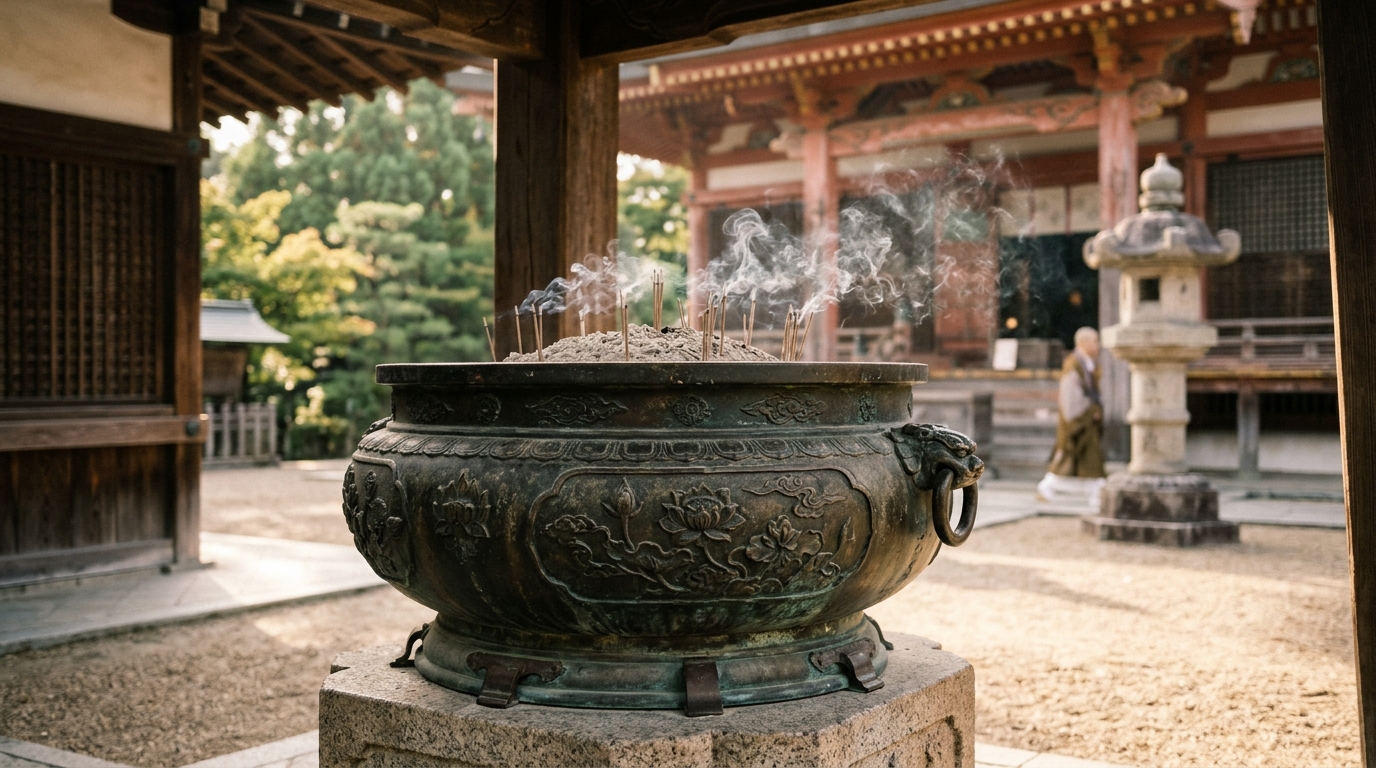
"Wafting fragrant smoke before silent prayer—the jokōrō is the threshold of a Japanese temple."
Learn jokōrō (常香炉) incense cauldron etiquette: 5 steps, 7 sects, and 5 famous temples.
30-Second Summary
- Smoke Purification: Temples purify with incense smoke, unlike Shinto water basins.
- Never Blow: Fan flames out by hand; human breath is taboo.
- 7 Sects: Jōdo Shinshū lays sticks flat and skips lifting shōkō to the forehead.
- Silent Bow: Join palms in Gasshō at the Main Hall; never clap.
Explore Sensō-ji—famed for its jokōrō cauldron—by drawing a fortune slip or trying Japanese prayer etiquette online.
1. What Is a Jokōrō? Incense Purification in Buddhism vs. Shinto Water
The jokōrō (常香炉)—literally "ever-burning incense cauldron"—is a large bronze or stone vessel placed in the courtyard directly in front of a Buddhist temple's Main Hall (Hondō). Its name reflects the custom of keeping incense embers smoldering continuously throughout temple opening hours so a steady plume of fragrant smoke greets arriving pilgrims. Depending on the temple, it is also called a daikōrō ("great incense burner") or sheltered beneath a roofed pavilion known as a kōkaku ("incense pavilion").
In Buddhist tradition, fragrance (kō / 香) stands alongside flowers and light as a foundational offering to the Buddhas. Classical scriptures speak of the Five Fragrance Virtues (Gobun Hosshin-kō)—morality, concentration, wisdom, liberation, and insight into liberation—comparing spiritual cultivation to pure perfume spreading naturally in every direction. Offering incense and breathing in its calm aroma is meant to clear distractions and steady the heart before bowing to the Principal Image (Honzon).
Notice how this sensory threshold distinguishes Buddhist temples from Shinto shrines across Japan. At Shinto shrines, purification relies on flowing fresh water at the Chōzuya water pavilion (5-step Chōzu guide), echoing ancient river ablutions (misogi). Although many Buddhist temples also maintain water basins inside their grounds, the signature pre-prayer purification before the Main Hall is incense smoke. For the broader distinction in architecture, gates, and gestures, see our complete Shinto Shrine vs. Buddhist Temple guide.
2. How to Use a Jokōrō: 5 Proper Steps (and Why You Never Blow Out the Flame)
When offering incense at a temple cauldron, follow these five calm, respectful steps to honor Buddhist precepts and keep neighboring visitors safe around open embers.
Obtain One Bundle of Incense Sticks Near the Cauldron
Visit the small counter or unmanned offering stand beside the jokōrō to pick up a single paper-wrapped bundle of incense sticks (hitosoku / 一束). Suggested donations vary by temple, so check the posted sign on-site and place small coins gently into the offering box. Remove any paper band if instructed before approaching the flame, disposing of it in the bin provided or carrying it out with you.
Light the Tip at the Dedicated Candle Stand
Approach the adjacent lighting stand (shokudai) or burner and hold the tips of your bundle at a slight angle in the flame until they catch evenly. Avoid lighting your sticks from another worshiper's burning incense inside the cauldron, which is considered discourteous and creates a burn hazard (note that a few temples hand out pre-lit sticks for crowd safety).
Wave Out the Flame by Hand — Never Blow With Your Mouth
Once a flame appears, gently fan the tip with your free hand—or give the bundle a calm downward flick—until only a glowing red ember and steady smoke remain. Blowing out the flame with your mouth is strictly taboo. In Buddhist ethics—reflected in the Five Precepts (such as refraining from false speech) and teachings on unwholesome speech—the mouth is regarded as a source of worldly defilement and craving, so blowing human breath onto an offering flame is considered disrespectful to the Buddhas.
Plant the Bundle Carefully Near the Center of the Ash
Step up to the cauldron and insert the smoldering bundle upright into an open spot toward the center or inner area of the ash bed rather than along the outer rim. Placing lit sticks close to the edge makes it easy for the next visitor reaching for smoke to burn a hand or sleeve. Take care not to bump or topple neighboring bundles.
Waft Smoke Toward Yourself, Then Bow Silently at the Main Hall (Never Clap)
Cup both hands and gently draw the rising incense smoke toward your head (a beloved folk custom praying for wisdom and clarity) as well as shoulders, knees, or any spot where you wish for comfort and wellbeing—understanding this as a traditional ritual of purification and prayer rather than medical treatment. Finally, proceed to the Main Hall, join your palms silently at chest height in Gasshō, and bow once deeply without clapping.
Shake the traditional fortune cylinder online to discover today’s fortune and timeless guidance for free.
3. Temple Jokōrō vs. Funeral Shōkō vs. Home Buddhist Altar Incense
Although English often groups all Japanese temple incense under one word, practice separates three very different settings: outdoor temple cauldrons, formal funerals and memorial services using granular incense (makkō), and daily home altars (butsudan).
| Setting | Incense Form | Core Purpose | Key Etiquette Rule |
|---|---|---|---|
| Temple Courtyard Jokōrō | Incense sticks (Senkō) (usually lit as a bundle) |
Pre-prayer smoke purification and offering before entering the Main Hall. | Fan out flame by hand, plant upright near the center, waft smoke gently, and bow silently at the Main Hall. |
| Funerals & Memorials (Oshōkō) | Granular incense (Makkō) (crushed aromatic wood chips) |
Paying final respects to the deceased and honoring the Buddhas. | Pinch granules with right thumb, index, and middle fingers; raise to forehead (or not, depending on sect) and drop gently onto lit charcoal 1–3 times. |
| Home Altar (Butsudan) | Incense sticks (Senkō) (counted by family sect) |
Daily morning and evening remembrance of ancestors and the family Buddha. | Follow the household's Buddhist school: typically 1 or 3 sticks standing upright, or 1 broken stick laid flat in Jōdo Shinshū. |
How Powdered Funeral Incense (Shōkō) Works in Practice
At Japanese funerals or memorial halls, oshōkō takes three formats depending on seating: standing (ryūrei), seated on tatami (zarei), or passing an incense tray down the row (mawashi-shōkō). When your turn comes, bow lightly to the bereaved family and clergy, offer a silent Gasshō bow toward the portrait and altar, pinch a small amount of makkō with your right thumb, index, and middle fingers, drop it smoothly onto the glowing charcoal inside the burner, and conclude with another quiet Gasshō bow.
4. Incense & Shōkō Differences Across 7 Major Japanese Buddhist Sects
While visitors at an outdoor jokōrō simply follow that temple's shared cauldron setup, home-altar incense and funeral shōkō follow distinct sectarian traditions. The chart below compares Japan's seven major Buddhist denominations, noting both major branches of Pure Land True School (Jōdo Shinshū).
| Buddhist Sect | Altar Stick Count & Placement | Shōkō Pinches | Forehead Gesture & Symbolism |
|---|---|---|---|
| Tendai-shū | 3 sticks (or 1), standing upright | No strict fixed rule (commonly 1 or 3 times) |
Raised to forehead; 3 sticks honor the Three Jewels (Buddha, Dharma, Sangha). |
| Shingon-shū | 3 sticks, standing upright (arranged in a triangle) |
3 times | Raised to forehead; symbolizes the Three Jewels or the Three Mysteries (body, speech, mind). |
| Jōdo-shū | 1 stick standing upright (local customs vary: 2–3 or laid flat) |
No strict fixed rule (often 1 to 3 times) |
Raised to forehead; emphasizes single-hearted devotion to Amida Buddha over rigid counting. |
| Jōdo Shinshū Hongwanji-ha (Nishi / West) |
1 stick broken and laid flat horizontally on the ash (never stood upright) | 1 time | Do NOT raise to forehead; drop directly onto the charcoal once. |
| Jōdo Shinshū Ōtani-ha (Higashi / East) |
1 stick broken and laid flat horizontally on the ash (never stood upright) | 2 times | Do NOT raise to forehead; drop directly onto the charcoal twice. |
| Rinzai-shū (Zen) | 1 stick standing in the center | 1 time | One mindful pinch; raising to the forehead varies by local temple tradition. |
| Sōtō-shū (Zen) | 1 stick standing in the center | 2 times | First pinch raised to forehead (primary offering); second pinch dropped without raising (secondary offering). |
| Nichiren-shū | 1 or 3 sticks standing upright | 1 or 3 times (clergy typically 3) |
Raised to forehead; expresses gratitude for the Lotus Sutra. |
Why Does Jōdo Shinshū Break Sticks Flat and Skip the Forehead Gesture?
Because Jōdo Shinshū views incense purely as a fragrant offering to Amida Buddha—not as a timer for seated meditation or a charm for self-purification—breaking a single stick into two or three pieces to fit the burner and laying them flat on the ash allows the incense to burn completely and evenly without leaving unburned stubs. Likewise, attendees omit raising powdered incense to the forehead because the fragrance belongs solely to the Buddha rather than cleansing the worshiper. When attending a funeral, it is completely proper to follow your own family's custom (or use one simple pinch if uncertain).
5. Five Iconic Japanese Temples Famous for Their Jokōrō Cauldrons
From bustling Tokyo precincts to historic pilgrimage capitals, these five temples showcase Japan's jokōrō culture across diverse Buddhist lineages.
| Temple (Location) | Sect & Principal Image | Cauldron Placement & Feature | Visitor Notes & Related Guides |
|---|---|---|---|
| Sensō-ji (Taitō-ku, Tokyo) |
Shō-Kannon-shū Head Temple (Shō-Kannon Bosatsu) |
Centered directly between Hōzōmon Gate and the Main Hall | Tokyo's best-known incense courtyard. Pair your visit with our Sensō-ji 30% Kyo Omikuji guide or compare sites in Sensō-ji vs. Meiji Jingu. |
| Zenkō-ji (Nagano City, Nagano) |
Non-denominational (tended jointly by Tendai Daikanjin & Jōdo Daihongan; Ikkō Sanzon Amida Nyorai) |
Large bronze Three-Lion Cauldron (San-jishi Daikōrō) between Sanmon Gate and Main Hall | Supported by three bronze lions, this celebrated cauldron welcomes pilgrims of every Buddhist school and background equally. |
| Naritasan Shinshō-ji (Narita, Chiba) |
Shingon-shū Chisan-ha Great Head Temple (Fudō Myōō) |
Covered Kōkaku Incense Pavilion before the Great Main Hall | Visitors gather around the sheltered cauldron for smoke purification before stepping inside for dramatic Goma fire ceremonies. |
| Kawasaki Daishi (Heiken-ji) (Kawasaki, Kanagawa) |
Shingon-shū Chisan-ha Great Head Temple (Yakuyoke Kōbō Daishi) |
Central courtyard directly in front of the Great Main Hall beyond Ōsanmon Gate | Renowned across Kanto for warding off misfortune; pilgrims purify themselves in thick incense smoke before praying inside. |
| Kiyomizu-dera (Higashiyama, Kyoto) |
Kita-Hossō-shū Head Temple (Eleven-Faced Thousand-Armed Kannon) |
Set near the Main Hall (Hondō) approach | Mountain breezes carry delicate incense fragrance across the historic wooden verandas overlooking Kyoto. |
Offering details, bundle prices, lighting arrangements, and festival crowd controls differ at every temple and may change seasonally. Always follow posted signs and attendants' directions on-site, and keep smoke sensitivity in mind for yourself and fellow travelers.
Taking a quiet moment to wave out an incense flame by hand, plant your bundle near the center of the ash, and bow in silent Gasshō turns a brief courtyard stop into one of the most memorable spiritual rituals of visiting Japan.
Related Guides to Explore Next
- Shinto Shrines vs. Buddhist Temples: Architecture & Etiquette
- Chōzu (Temizu): 5-Step Shinto Water Purification Guide
- Why Sensō-ji Omikuji Has 30% Bad Luck (Kyo) Explained
- Sensō-ji vs. Meiji Jingu: Which Tokyo Landmark Should You Visit?
- Joya no Kane: Why 108 Temple Bells Ring on New Year's Eve
- Jizō Statues in Japan: Meaning of Red Bibs & Temple Etiquette
- Best Shrines and Sacred Spots in Tokyo
- Shichifukujin: The Seven Lucky Gods Pilgrimage Guide
- Gotokuji Temple vs. Imado Shrine: Tokyo Maneki-neko & Temple Etiquette
Frequently Asked Questions
- Why must you never blow out incense flames by mouth at Japanese Buddhist temples?
- In Buddhism, the human mouth is associated with unwholesome speech and impurity, so blowing directly onto sacred incense offerings for the Buddhas is disrespectful. Instead, extinguish the flame by gently fanning it with your free hand.
- Why do visitors waft jokoro incense smoke onto their head and body at Sensoji or Zenko-ji?
- Fragrant temple smoke is believed to purify body and mind before prayer. Visitors use their hands to draw smoke toward aching joints for healing or onto their head for wisdom and academic focus before offering silent Gassho (never clapping) at the main hall.
- How does temple jokoro etiquette differ from funeral shoko powdered incense and home altars?
- At outdoor temple jokoro burners, visitors light bundled incense sticks for purification. At Buddhist funerals (shoko), mourners pinch powdered incense 1–3 times according to sect tradition. On home altars (butsudan), most sects stand sticks upright, whereas Jodo Shinshu snaps and lays a single stick flat.
Choose Senso-ji Temple and draw an omikuji (free)
Shake the traditional fortune cylinder online to discover today’s fortune and timeless guidance for free.
More Japanese Sacred Traditions

October 29, 2026
Sensoji Temple Omikuji Guide: Why 30% Draw Kyo & All 7 Levels (2026)
Why do 30% draw Kyo (bad fortune) at Asakusa Sensoji Temple? See exact Kannon Hyakusen 100-slip odds (17% Daikichi, 0% Chukichi), ¥100 ritual & tying rules.

February 12, 2026
Shrine vs Temple in Japan: 5 Major Differences & Prayer Etiquette (2026)
Shrine vs temple in Japan: spot Torii vs Sanmon gates, 2-bow 2-clap 1-bow vs silent Gassho (never clap), Kami vs Buddha, plus Shinbutsu-shugo history.

November 30, 2025
Chōzu: 5-Step Hand Purification at Japanese Shrines (2026)
How to perform Chōzu (Temizu) purification at a Japanese shrine: 5 steps with one ladle, Izanagi's Misogi myth, Hanachozu flower basins & left-handed tips.